
Data Center Liquid Cooling Training: What Technicians Must Learn for AI Racks
What technicians must know to work on liquid-cooled AI racks, from CDUs and quick disconnects to leak response and pump failover, and how to train for it.
TL;DR
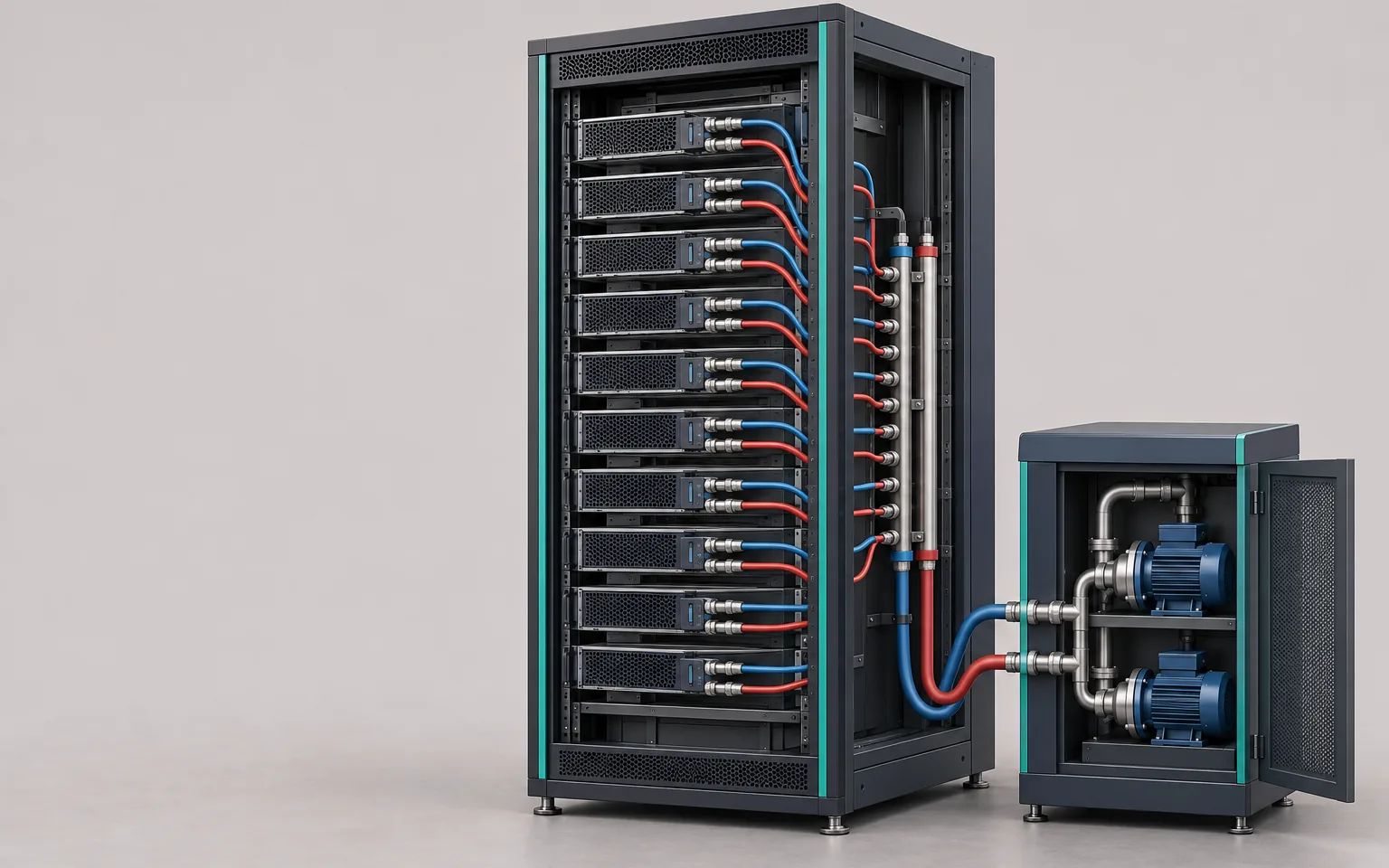
- Direct-to-chip cooling uses two loops: the technology cooling system (TCS) that feeds the cold plates, and the facility water system (FWS) that rejects the heat. A coolant distribution unit (CDU) separates them.
- Technicians must know the normal state of each CDU, how to connect racks with quick disconnects, how to respond to a leak alarm, and what to check when a pump fails.
- ASHRAE TC 9.9 cites research in which processors began to throttle as little as 23 seconds after a CDU pump failure, so technicians have very little time to act.
- Fluid quality needs attention for the life of the system. Filtration and regular tests of pH, conductivity, glycol, inhibitor, and turbidity keep the cold plates clear.
- Practice faults in a simulation first, then move to supervised live work.
Why liquid cooling changes the technician's job
In an air-cooled hall, a team usually has minutes to respond to a cooling problem. Direct-to-chip cooling leaves far less time. The coolant runs through cold plates on the GPUs and CPUs, and if the flow stops, the chips heat up fast.
An ASHRAE TC 9.9 technical bulletin on cold plate resiliency cites research with medium-power processors in which throttling began as little as 23 seconds after a CDU pump failure, and today's AI processors run at higher power. The bulletin also reports TCS temperature jumps of as much as 27°C (48.6°F) during a CDU pump changeover on systems without active redundancy.
Data center liquid cooling training has to teach technicians to recognize a fault, choose the correct response, and carry out the steps in the correct order, even though few of them have ever seen a real cooling fault.
How direct-to-chip cooling works: FWS, TCS, and the CDU
Most direct-to-chip systems use two separate liquid loops with a CDU between them, as the ASHRAE TC 9.9 white paper on water-cooled servers describes.
- The technology cooling system (TCS) is the closed loop that runs from the CDU to the racks, through manifolds, hoses, quick disconnects, and cold plates.
- The facility water system (FWS) is the building loop. It carries heat from the CDU to chillers, dry coolers, or cooling towers.
- Between them sits the coolant distribution unit (CDU), a liquid-to-liquid heat exchanger with its own pumps, filters, valves, and controls.
| Facility water system (FWS) | Technology cooling system (TCS) | |
|---|---|---|
| Serves | CDU heat exchangers and other building equipment | Cold plates inside the IT equipment |
| Usual owner | Building owner and facilities staff | Often a mix of CDU vendor, IT provider, and engineering firm |
| Water quality | Less strict, large flow passages | Stricter, very small cold plate channels |
According to the white paper, the most common water quality mistake is to apply the wrong guideline to the wrong loop, and TCS water quality needs a clear owner. That makes the loop boundaries the first thing to teach.
What technicians must learn about the CDU
The ASHRAE white paper lists the main jobs of the CDU: it transfers heat from the TCS to the FWS, circulates the TCS coolant, keeps the TCS coolant chemistry separate from the facility loop, and holds the TCS above the room dew point to prevent condensation.
Know the normal state
To spot an abnormal reading, a technician first needs a clear picture of what normal looks like. For each CDU, trainees should be able to state:
- Which pump is lead and which is standby.
- The supply temperature set point and the normal return temperature.
- Normal TCS flow and differential pressure, and their alarm limits.
- Normal filter differential pressure, and the value that calls for a filter change.
- The reservoir level and the normal position of each isolation valve.
They should also be able to read active alarms and alarm history on the CDU screens, and know which actions need a method of procedure (MOP).
Quick disconnects and rack connections
Quick disconnects (QDs) let a technician connect a rack to the TCS without draining the loop. They are also a common spot for slow weeps, so follow the manufacturer's procedure every time.
Rack connection checklist
- Inspect both halves for damage, debris, and seal condition. Keep the dust caps on until connection.
- Verify supply-to-supply and return-to-return before you energize anything.
- Engage the coupling fully, and confirm that it is latched.
- Bleed air at the vents after each rack or bank of racks.
- Look for drips under flow, and again at operating temperature.
- Record the connection, the readings, and any fluid makeup.
Steps 2 and 4 come from the ASHRAE TC 9.9 bulletin on TCS commissioning. The same bulletin warns that the factory fluid in new IT equipment can differ from the site fluid, and that incompatible fluids can cause inhibitor precipitation, corrosion, or fouling. Check compatibility before the first connection.
Leak detection and leak response
The Open Compute Project white paper on leak detection and intervention divides detection into two groups:
- Direct detection uses leak detection rope, point detectors, and floats. The liquid has to touch the sensor and must be electrically conductive.
- Indirect detection relies on changes in differential pressure, a falling reservoir level, optical sensors, and turbidity sensors.
The paper also sets out levels of intervention. With manual intervention, the system sends a notification and people act on it. Automatic intervention can de-energize the IT equipment and, in some designs, shut off the coolant as well.
A leak response drill
- Read the alarm: which sensor, which zone, and which CDU.
- Check the CDU for a falling reservoir level or a change in pressure.
- Go to the location with the correct PPE. Do not touch energized equipment in standing liquid.
- Find the source, and use the site's emergency operating procedure (EOP) to decide what to isolate.
- Tell the IT owner before any action that stops cooling to IT equipment.
- Clean up, record the fluid lost and the makeup added, and open a work order.
Pump failover and loss of cooling
The ASHRAE resiliency bulletin recommends active redundancy on the TCS and FWS loop pumps, UPS power so that the TCS keeps running when utility power fails, and thermal energy storage to carry cooling through the transfer to generator power.
Technicians need to know how their own site's design behaves. During a pump trip, they work through these checks:
| Step | What the technician checks |
|---|---|
| 1. Alarm | The pump fault alarm at the CDU and the BMS, and its time stamp |
| 2. Failover | The standby pump starts and becomes the lead pump |
| 3. Recovery | TCS flow and differential pressure return to the normal range |
| 4. Temperature | Supply temperature returns to set point, with no high-temperature alarms at the racks |
| 5. Cause | The fault code at the pump drive or controller, then the pump and its power supply |
| 6. Status | The CDU now has no standby pump. Escalate and plan the repair |
Filtration and fluid quality
Cold plates have very narrow channels, and particles, corrosion products, or biological growth can block them.
The Open Compute Project guidelines for propylene glycol-based heat transfer fluids describe two filtration methods. Sidestream filtration continuously sends a small share of the flow, typically 5 to 15 percent, through a filter, so the full volume passes the filter at least once a day. Full-flow inline filtration treats all of the flow. Many CDUs also carry coarser inline filters, such as 25 or 50 micron, to protect the heat exchangers and quick disconnects.
The ASHRAE TCS bulletin lists the minimum fluid parameters to measure: pH, conductivity, glycol concentration, inhibitor reserve, and turbidity. It also says to take samples only after the system reaches thermal and hydraulic steady state, since a sample taken during a transient will not represent the loop.
Fluid mistakes to train out
- Topping up with the wrong fluid or the wrong concentration.
- Filling glycol too fast, which causes foam and trapped air.
- Ignoring a slow rise in filter differential pressure.
What the ASHRAE and OCP guidance covers
Start with the IT equipment manufacturer's requirements. The ASHRAE resiliency bulletin says that the manufacturer's coolant quality specifications must be followed.
| Document | Use it for |
|---|---|
| ASHRAE TC 9.9, Water-Cooled Servers | Loop names, CDU functions, FWS versus TCS water quality |
| ASHRAE TC 9.9, Resiliency Guidance for Cold Plate Deployments | Pump redundancy, thermal inertia, S-classes |
| ASHRAE TC 9.9, TCS Commissioning | Flushing, filling, thermal cycling, rack connections |
| OCP, Propylene Glycol-Based Heat Transfer Fluids | Fluid properties, filtration, monitoring |
| OCP, Leak Detection and Intervention | Detection methods and intervention levels |
ASHRAE uses S-classes to classify the maximum coolant inlet temperature to IT equipment. When the resiliency bulletin was published, they ranged from 30°C to 50°C (86°F to 122°F). Our guide to data center commissioning levels shows where liquid cooling fits into the testing stages of a new build.
A data center liquid cooling training curriculum
The modules below are a practical starting point. Adapt them to each site's equipment and procedures.
| Module | Trainees learn to | How to check it |
|---|---|---|
| 1. Loops | Trace the FWS and TCS on site drawings | Label a blank loop diagram |
| 2. CDU normal state | Read the CDU screens and state normal values | Walk-through with an assessor |
| 3. Rack connections | Connect quick disconnects, vent air, check for leaks | Practical exercise, then a supervised live task |
| 4. Leak response | Follow the site EOP from alarm to work order | Timed drill in a simulation |
| 5. Pump failover | Recognize a pump trip, confirm failover, escalate | Fault scenario in a simulation |
| 6. Fluid quality | Take samples, read filter trends, top up correctly | Practical exercise with a checklist |
Assess each module with a practical exercise in addition to any quiz. Our article on data center technician skills assessment explains how to set one up, and data center training programs covers the structure of a full program.
Practice faults before live work
Real faults are rare, and nobody should trip a pump on a production AI cluster to train a new hire. A good simulated drill starts from the normal state, introduces one fault, and asks the trainee to find it and respond. It records each action and the order it happened in, then tells the trainee specifically what they missed and why it matters.
Fault drills to include
- The CDU lead pump trips, and the standby pump starts.
- Filter differential pressure rises above the alarm limit.
- A leak alarm in one rack zone, with a falling reservoir level.
- TCS supply temperature rises because the FWS supply is too warm.
- Air in the loop after a rack connection, with unstable flow.
After the simulation, move trainees to supervised live work on low-risk tasks. Add these drills to data center technician onboarding and repeat them on a schedule. A browser-based simulation runs on a supported computer with a modern browser, and our VR vs. browser simulation training article compares it with headset-based training.
How Oasis helps
We build browser-based 3D simulations of data center equipment and procedures. Each one follows the customer's equipment, procedures, and site standards, and we review the steps and feedback with the customer's team.
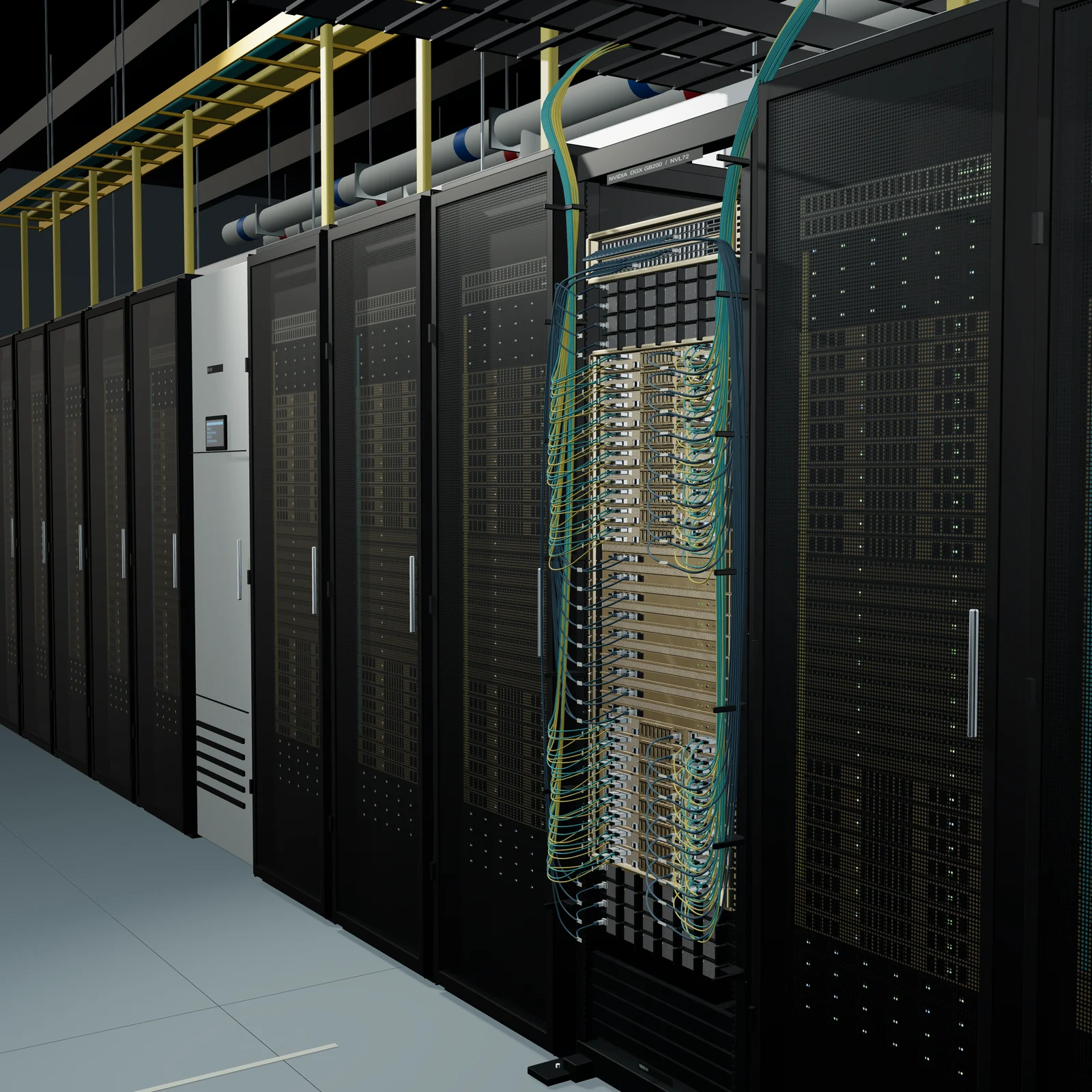
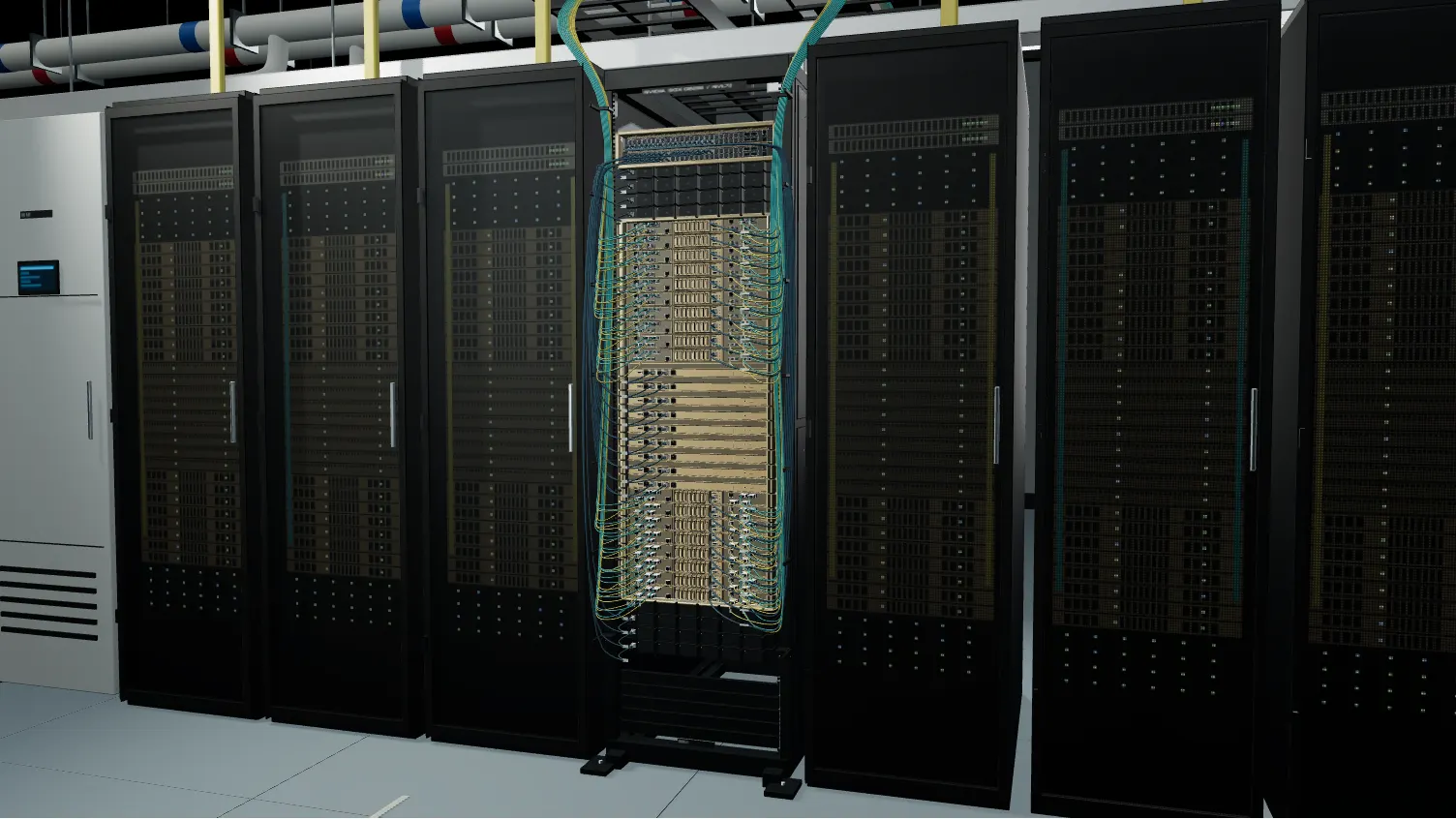
For liquid cooling, we can simulate your own CDUs, manifolds, quick disconnects, and racks, along with the faults your team has to handle, such as a pump trip or a leak alarm. The CDU and GB200 rack scenes on this site are examples, and we build to whatever your site needs. This work supports our onboarding, training, and operations and maintenance data center programs.
You can try a data center simulation in your browser now. To talk about liquid cooling training for your site, book a 15-minute call.
Frequently asked questions
What is the difference between FWS and TCS in data center liquid cooling?
The facility water system (FWS) is the building loop that carries heat from the CDU to chillers, dry coolers, or cooling towers. The technology cooling system (TCS) is the closed loop from the CDU to the cold plates. The TCS has much stricter fluid quality and filtration requirements.
What does a CDU do in a data center?
A coolant distribution unit (CDU) transfers heat from the TCS to the FWS through a heat exchanger. It pumps and filters the TCS coolant, controls its temperature and pressure, and keeps its chemistry separate from the facility water.
What happens if a CDU pump fails?
In a redundant design, the standby pump starts and flow recovers. Without fast failover, chips can overheat within seconds. The technician's job is to confirm the failover, find the cause, and escalate.
How do you detect a leak in a liquid-cooled rack?
Direct methods use leak detection rope, point detectors, or floats, which react when a conductive liquid touches them. Indirect methods watch for pressure changes, a falling reservoir level, or optical and turbidity sensors. Regular visual rounds find slow weeps that sensors miss.
How long does liquid cooling training take for data center technicians?
It depends on the technician's experience and the site's equipment. Move each person to the next module once a practical exercise shows they can do the task, however many hours that takes.
Sources
- Liquid Cooling: Resiliency Guidance for Cold Plate Deployments (Technical Bulletin), ASHRAE TC 9.9
- Water-Cooled Servers: Common Designs, Components, and Processes, ASHRAE TC 9.9
- TCS Commissioning: Bringing a New Liquid Cooling System Online (Technical Bulletin), ASHRAE TC 9.9
- Guidelines for Using Propylene Glycol-Based Heat Transfer Fluids in Liquid Cooled Racks, Open Compute Project
- ACS Cold Plate: Leak Detection and Intervention White Paper, Open Compute Project
Related articles
 10 min read
Data Center Commissioning Levels: A Field Guide to L1 Through L5
What happens at each of the five data center commissioning levels, who does the work, which tests to expect, and how to prepare your team.Read guide 9 min read
Data Center Technician Skills Assessment: How to Test Practical Skills Before You Hire
Which tasks to test in data center technician candidates, how written, hands-on, and simulation exercises compare, how to score each candidate fairly, and the legal basics.Read guide 8 min read
Data Center Technician Onboarding: A Practical 30/60/90-Day Plan
An onboarding plan for new data center technicians that covers preparation, the first week, 30/60/90-day goals, LOTO and arc flash awareness, MOPs and EOPs, shadowing, practice, and competence checks.Read guide