
Data Center Technician Skills Assessment: How to Test Practical Skills Before You Hire
Which tasks to test in data center technician candidates, how written, hands-on, and simulation exercises compare, how to score each candidate fairly, and the legal basics.
TL;DR
- Base the assessment on a short job analysis and test only the tasks a new hire must do from day one.
- Mix methods: a short written test for safety rules and theory, then a hands-on or simulation exercise for procedure skills.
- Score every candidate with the same rubric, and decide before the first candidate starts which safety errors end the exercise.
- Under the US Uniform Guidelines, a test that has adverse impact must be job-related. Keep records and offer accommodations.
- Treat the score as one input to the hiring decision, together with interviews and references.
Why resumes and interviews miss practical skills
An interview tells you what a candidate says they can do, and a certificate shows that they finished a course. Neither shows how the person works through a procedure on critical equipment.
Uptime Institute considers the interaction between people and the infrastructure they manage to be the leading cause of data center outages, as its article on writing a good method of procedure explains.
A practical data center technician skills assessment closes part of that gap. The candidate does a sample of the work while you watch. We build these exercises at Oasis, and the ones that work best cover a few specific tasks and follow the site's own procedures.
Start with a job analysis
Before you pick a test format, write down what the job involves. A one-page job analysis is enough for most teams.
- List the tasks a technician does in a normal month. Use work orders, MOPs, and shift logs as the source.
- Rate each task for frequency and for the consequence of an error.
- Mark which tasks a new hire must do from the start and which tasks you will teach on the job.
- Test only the first group. Teach the second group in onboarding.
Step 3 matters for fairness. The EEOC's questions and answers on the Uniform Guidelines state that content validity is not appropriate for knowledge, skills, or abilities an employee is expected to learn on the job. Do not test a candidate on your site's switching sequence if you plan to teach it in week three.
| Task | Consequence of error | Test before hiring |
|---|---|---|
| Follow a written MOP step by step and stop on a mismatch | High | Yes |
| Read a one-line diagram and find an upstream breaker | High | Yes |
| Identify UPS normal, bypass, and maintenance bypass states | High | Yes, at awareness level |
| Do a generator monthly test walk-down | Medium | Yes, for experienced hires |
| Run your site's specific switching sequence | High | No, teach on the job |
| Use your CMMS and ticket system | Low | No, teach on the job |
Written tests, hands-on tests, and simulation exercises compared
The EEOC fact sheet on employment tests and selection procedures lists sample job tasks, such as performance tests, simulations, and work samples, as one type of selection procedure. Most teams combine two of the three formats below.
| Format | What it shows well | Limits |
|---|---|---|
| Written or online test | Safety rules, terms, electrical and cooling theory, diagram reading | Does not show sequence, pace, or what a person does when a step fails |
| Hands-on test on real equipment | Physical skill, tool use, torque, cable handling | Needs de-energized training gear and a proctor. Hard to make identical for every candidate. You cannot inject faults on live equipment. |
| Simulation exercise | Procedure order, checks, response to alarms and faults, the same scenario for every candidate, a log of every step | No physical feel for force or weight. Candidates who rarely use a computer may need a practice round or an accommodation. |
One pattern that works well is a 20-minute written test to screen for safety knowledge, followed by a 30 to 45-minute simulation or hands-on exercise for procedure skill. We compare the delivery options in more detail in VR vs. browser simulation training.
What tasks to test for data center technicians
Choose three to five tasks from your job analysis. Each task should have a clear start state, a clear end state, and steps you can observe.
Electrical
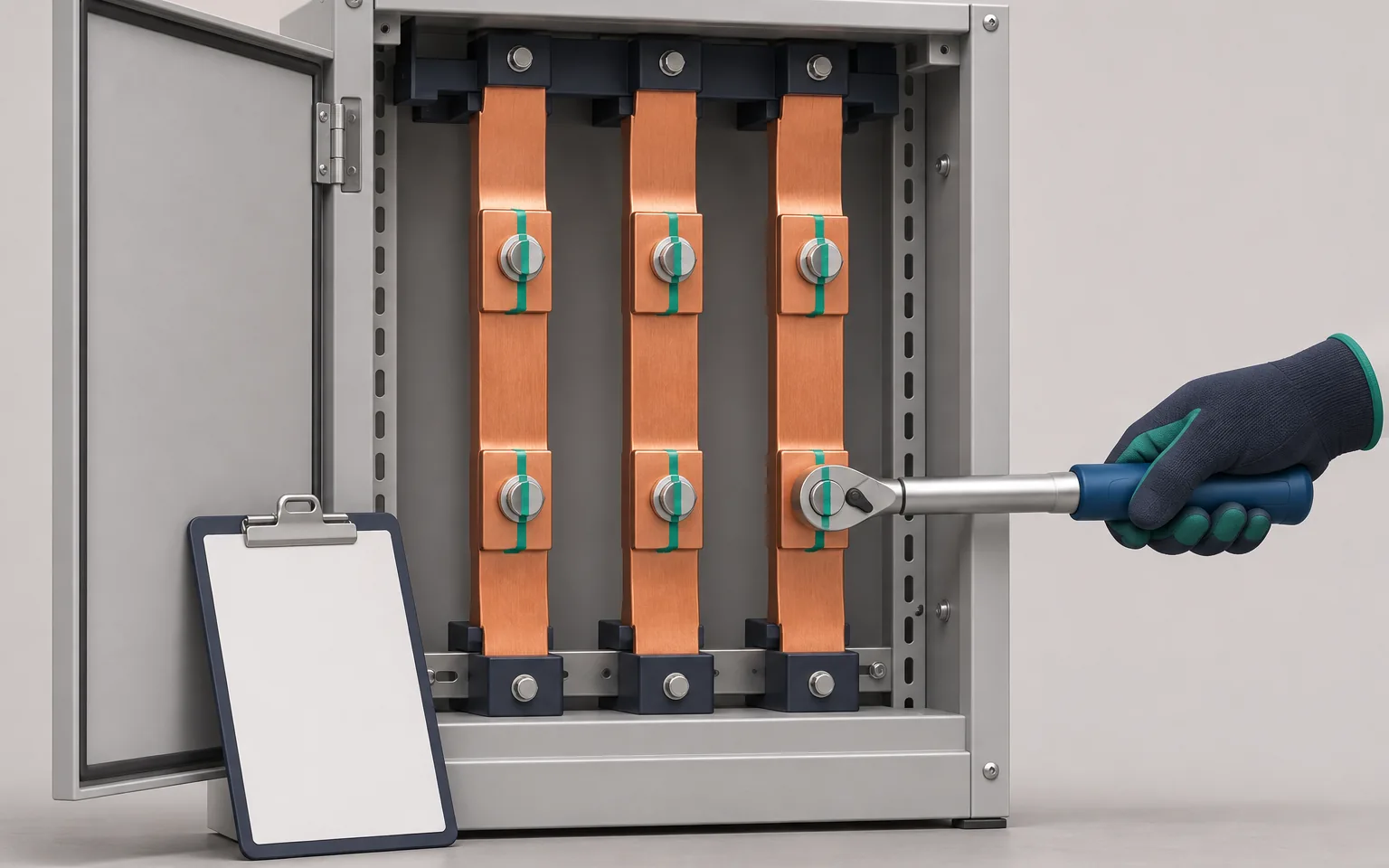
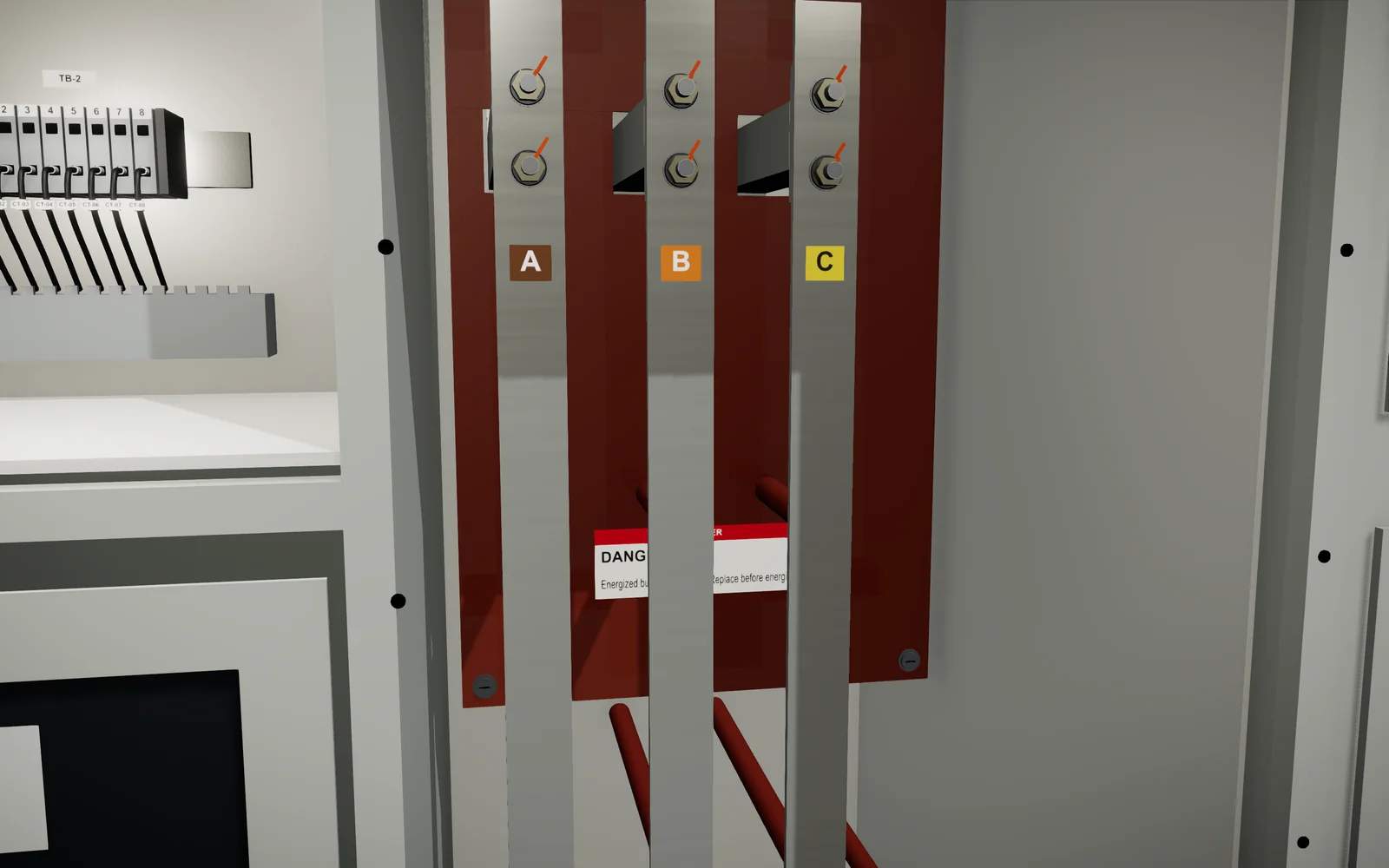
- Inspect a switchgear section and report a bolted bus joint with a missing or broken torque mark.
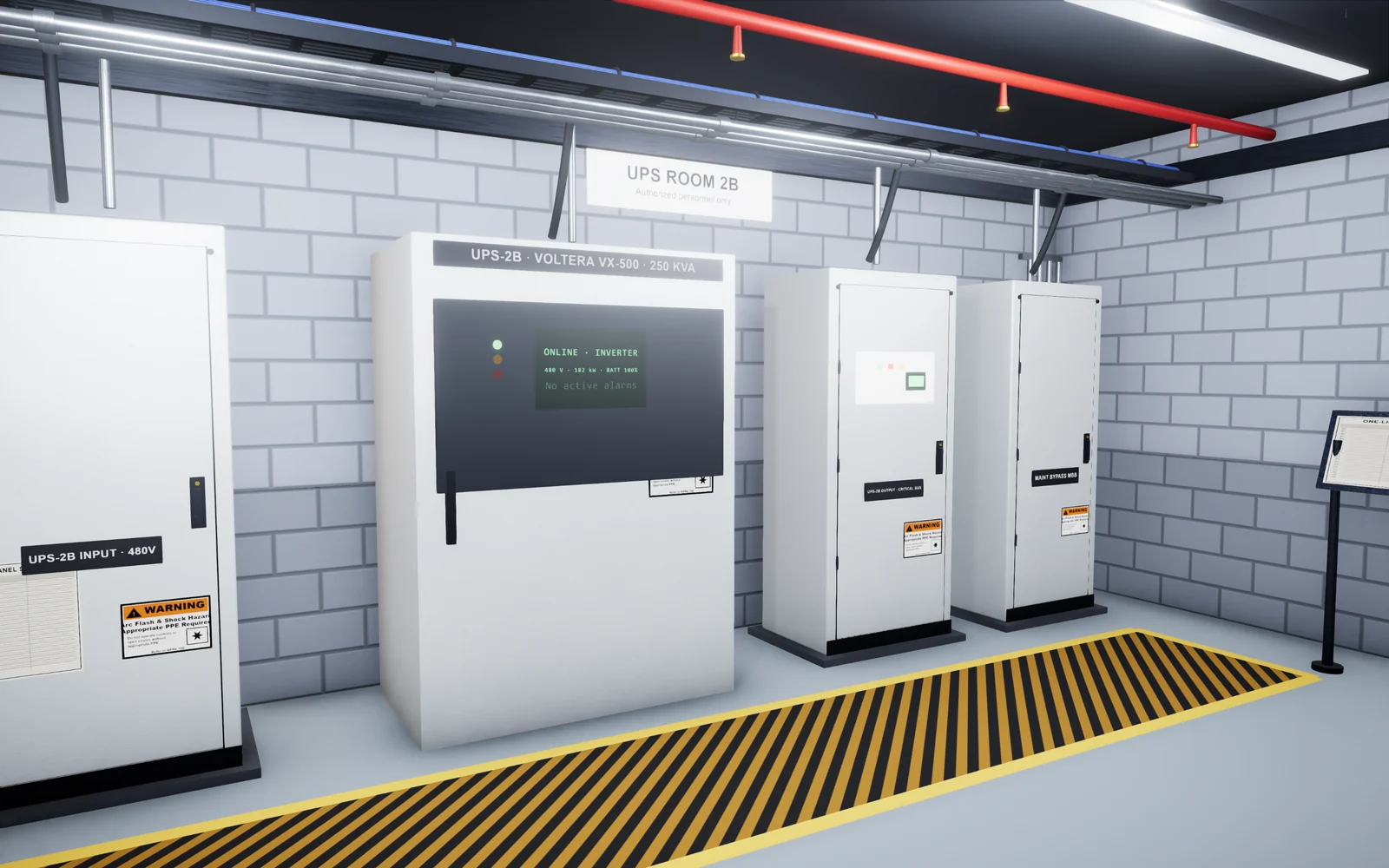
- Identify the input, output, and maintenance bypass cabinets in a UPS lineup and state the current mode.
- On a one-line diagram, find every isolation point a lockout for a given panel needs.
Mechanical and cooling
- Respond to a CDU pump-trip alarm in a liquid-cooled hall by following the written EOP.
- Read valve positions and say whether a loop is in its normal configuration.
Generator and white space
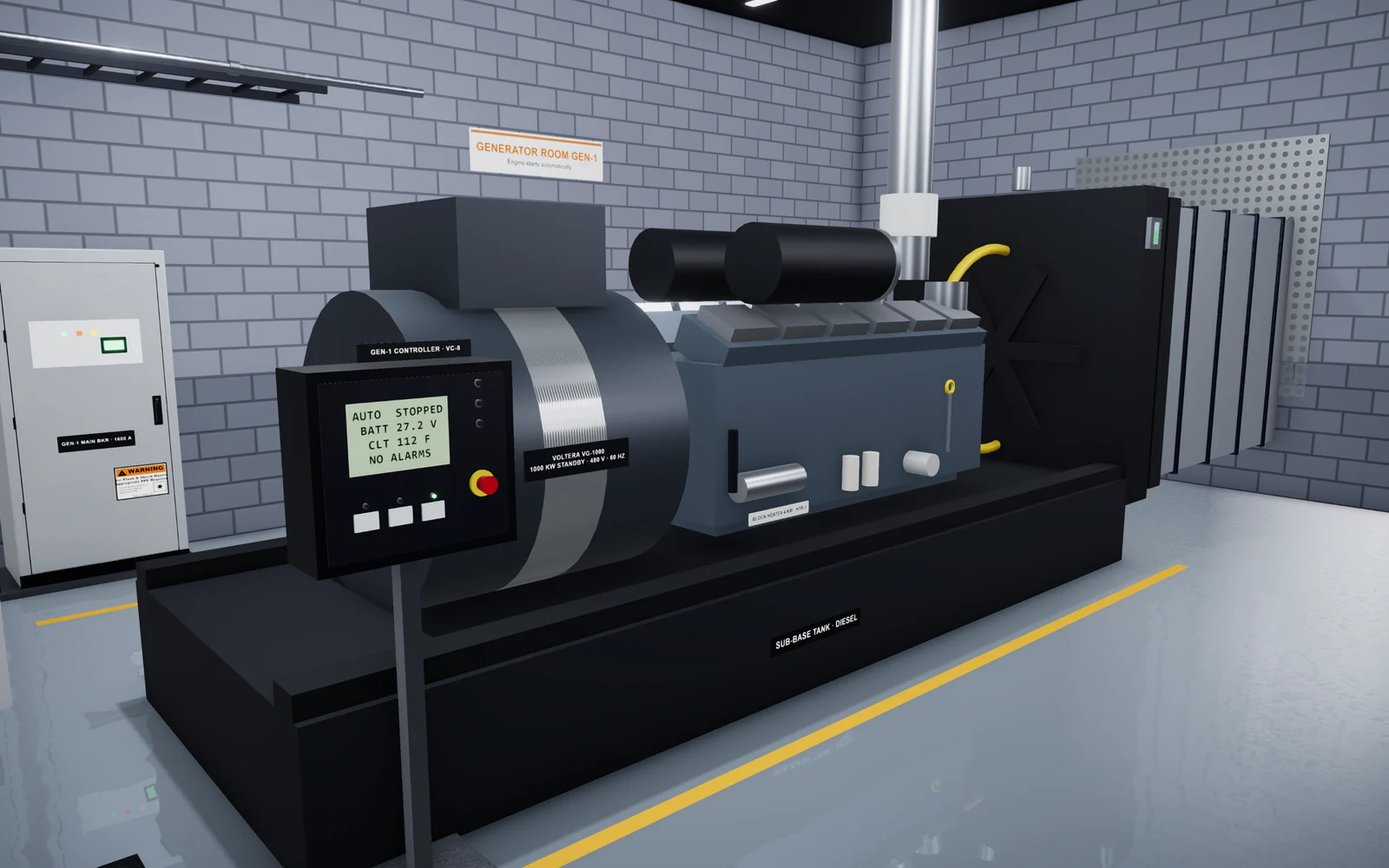
- Do a pre-start walk-down for a generator monthly test and confirm the controller returns to AUTO.
- Trace and reseat a management cable to the correct port on a rack, and check the label.
Procedure discipline
Test this in every exercise. Uptime Institute's MOP guidance says each step should state exactly what to do and the expected result. A good candidate checks the result after each step. When the result does not match, they stop and escalate.
Example exercise: UPS lineup walk-through with a planted fault
This is the outline of an exercise we would build, with steps taken from the employer's own MOP.
- The candidate reads a short MOP extract. It has five steps and an expected result for each step.
- The candidate confirms that the starting state matches the MOP. In this version, one alarm is already active.
- The candidate must notice the alarm, stop, and report it before step one.
- After the reviewer clears the alarm, the candidate does the steps and states each expected indicator change.
- The candidate writes a two-line shift note about what they found.
The exercise covers reading, checking, stopping, and communicating. The employer's full switching sequence is left for training after the hire.
How to score fairly: a sample rubric
Write the rubric before you test anyone, and give it to every rater. Each criterion scores 0, 1, or 2.
| Criterion | 0 | 1 | 2 |
|---|---|---|---|
| Checks start state | Does not check | Checks part of it | Checks all of it and notes the alarm |
| Follows step order | Skips or reorders steps | Correct order with prompts | Correct order without prompts |
| Verifies results | No checks | Checks some steps | States the expected result at each step |
| Stops on a mismatch | Continues | Hesitates, then continues | Stops and escalates |
| Communicates | No note | Note is incomplete | Clear note with time, equipment, and action |
- Give every candidate the same instructions, time limit, and scenario.
- Use two raters, or one rater plus an automatic step log, and compare scores.
- Calibrate raters on two practice runs before live use.
- Set the pass level before testing. Under Title VII, the EEOC fact sheet says employers may not adjust scores or use different cutoff scores on the basis of race, color, religion, sex, or national origin.
Legal and fairness basics: job-relatedness under the Uniform Guidelines
In the US, the Uniform Guidelines on Employee Selection Procedures (29 CFR Part 1607) set the framework for tests used in hiring. The EEOC adopted them in 1978 with the Department of Labor, the Department of Justice, and the Civil Service Commission. Five points apply most directly to a skills test. The first four come from the guidelines, and the fifth comes from the ADA, as the EEOC fact sheet explains.
- A procedure that has adverse impact on a race, sex, or ethnic group is discriminatory unless it is validated. As a rule of thumb, the guidelines treat a selection rate below four-fifths of the highest group's rate as evidence of adverse impact.
- If there is adverse impact, the employer must show the test is job-related and consistent with business necessity.
- For work samples, employers usually support content validity by showing that the test content is a representative sample of important work on the job. Your job analysis is the start of that evidence.
- Keep data on who took the test and who passed, by group, so you can check for adverse impact.
- Under the ADA, employers must make reasonable accommodations in how they give tests, unless this causes undue hardship.
The guidelines also ask employers to consider other procedures with less adverse impact when two procedures serve the same purpose about equally well.
Use the score as one input to the hiring decision
The Department of Labor's guide Testing and Assessment: An Employer's Guide to Good Practices says that all assessment tools are subject to errors. It recommends a whole-person approach in which no single test carries too much weight.
- Combine the exercise score with a structured interview, references, and relevant certifications.
- Ask the candidate to explain a step they missed, because the answer often tells you more than the score does.
- When a score is borderline, look more closely at the candidate's work before you decide.
- Pass the score report to the hiring manager so the onboarding plan starts with the real gaps.
Do not describe the result as a prediction of job performance unless you have a proper validation study. Call it an observed sample of practical skill.
A checklist for your first assessment
- Write a one-page job analysis with task, frequency, and consequence.
- Choose three to five tasks that new hires must do from day one.
- Pick the format for each task: written, hands-on, or simulation.
- Write the rubric and the list of errors that end the exercise.
- Run the exercise with two current technicians and fix unclear steps.
- Calibrate raters and set the pass level.
- Publish the accommodation process to candidates.
- Record results by group and review impact each quarter.
- Review the tasks when your equipment or procedures change.
If you also need to plan training after the hire, see our guide to data center training programs.
How Oasis helps
Oasis Simulations builds custom 3D simulations, aptitude tests, and skills assessments for data centers and the physical trades. Candidates take them in a web browser. We build each scenario around your equipment, procedures, and site standards. Then we review the steps and the feedback with your team before anyone uses it.
We can build an assessment around any task you hire for, on any equipment. The scenes on this site are only examples of what we build. You can try a data center simulation in your browser, read about our data center programs, or see how we build a program. If you want to talk it through, book a 15-minute call.
Frequently asked questions
What should a data center technician skills test include?
Include a short written section on safety rules and theory, and one or more practical exercises. Good exercises include reading a one-line diagram, identifying UPS modes, following an MOP, and responding to an alarm with an EOP. Pick the tasks from your own job analysis.
Is a simulation-based assessment legal to use in hiring?
The EEOC lists simulations and work samples as types of selection procedures. Like any test, a simulation must not discriminate. If it has adverse impact, you must show it is job-related and consistent with business necessity. Offer reasonable accommodations and ask your employment counsel to review it.
How long should a practical skills assessment take?
Most entry-level assessments fit in 60 to 90 minutes: about 20 minutes of written questions and one or two practical exercises of 30 to 45 minutes.
Can a skills assessment predict how a technician will perform?
Not by itself. A skills exercise shows how a candidate did on a sample of tasks on one day. Claims about prediction need a proper validation study. Use the result with interviews and references to support your decision.
Should I test candidates on our site's specific procedures?
Only on general procedure skills, such as reading steps and stopping on a mismatch. Teach site-specific sequences during onboarding. The EEOC's guidance says content validity does not suit skills an employee is expected to learn on the job.
Sources
- Employment Tests and Selection Procedures, U.S. Equal Employment Opportunity Commission
- 29 CFR Part 1607: Uniform Guidelines on Employee Selection Procedures (1978), Electronic Code of Federal Regulations
- Questions and Answers to Clarify and Provide a Common Interpretation of the Uniform Guidelines on Employee Selection Procedures, U.S. Equal Employment Opportunity Commission
- Testing and Assessment: An Employer's Guide to Good Practices, U.S. Department of Labor, Employment and Training Administration
- The Making of a Good Method of Procedure, Uptime Institute Journal
Related articles
 8 min read
Data Center Technician Onboarding: A Practical 30/60/90-Day Plan
An onboarding plan for new data center technicians that covers preparation, the first week, 30/60/90-day goals, LOTO and arc flash awareness, MOPs and EOPs, shadowing, practice, and competence checks.Read guide 10 min read
Data Center Training Programs: The Best Certifications and Courses for 2026
The data center training programs and certifications we recommend for 2026, with the audience, format, content, and official link for each. We also cover how to choose one and how certifications differ from site-specific training.Read guide 10 min read
VR vs Browser-Based Simulation Training: A Fair Comparison for Trades and Data Center Teams
How VR headset training and browser-based 3D simulation compare on hardware, cost, remote candidates, realism, simulator sickness, accessibility, updates, and reporting, and where each one fits best.Read guide